embodied transmission
__________
Volume 16, Edition 1
Author: Aimee Raitmain
___________
I write on my process and practice.
In writing, and in developing a work, I let things fall out and emerge. In many ways, this is also the experience of the dance. ‘The dance’ is something I define as separate to ‘dancing.’ ‘The dance’ has a beginning and an end, which don’t necessarily happen in consequent order, but it feels like when you are in ‘the dance,’ you know.
‘The dance,’ or my dance, is my container for separating what happens when you are in, and everything else.
I have found myself in a continuum of learning, researching, making and sharing work over the past year or so. My work has used Contact Improvisation as its primary medium. My practice feels like a tumbleweed. It collects bits, keeps rolling, leaves some things behind, and is rather messy. But my inquiry and investment in this tumbleweed of Contact Improvisation and choreographic practice is nothing if not persistent.
I reference some moments below that have influenced my dance or expanded my thinking around my process and practice of Contact Improvisation.
There are many more that have regrettably been left out.
Lineage was the term I had used for a long time in thinking about my relationship to Contact Improvisation. In a piece performed by Martin Hughes and I, with sound by Callum Cheah, we talked and moved about our dancing histories, referencing time and memory (After This, Out of Bounds, Lucy Guerin Inc., 2026).
Unpacking and reflecting on this performance in the weeks following, became a part of the creative process too, and I came to better understand the underscore of the piece. It led me to a conversation with Em Bowman (Monday night jam, Dancehouse, 2026), which recalibrated my understanding of myself in relation to Martin and others, untethered from time and place.
I now consider a more accurate framing to be constellations over lineage.
The following weekend: The Melbourne Jam 30 Year Celebration.
Relationships, embodied transmission, technique, and lineages but in a non-linear way. Influence and divergence. Moving towards and moving away. (Noting that moving away, is still relational.) Constellations over lineages. Unfamiliar influences. A first dance with an unfamiliar body whose constellations hardly overlap with mine, and many first dances with unfamiliar faces, yet bodies whose orbits encompass my entire and outermost kinespheres and skinespheres. Interesting noticing the contrast of a familiar shared embodied language, and rather unfamiliar inflections in other first dances. It is freeing to dance with bodies before learning their names and the jams that they frequent.
An unexpected collision occurs.
I notice when I speak the same physical language as someone of an earlier generation. I come to sense trust. Some dancing bodies carry a particular intonation, a certain dialect of a place, and the influences of the people that make up that place. I have inherited some of these inflections, while others have mutated over time.
Martin made a comment once during our rehearsal for Out of Bounds (WXYZ Studios, 2026), about an assured unpredictability to our dance. I note that his body is probably one that I have been in contact with most consistently since encountering Contact Improvisation in Melbourne.
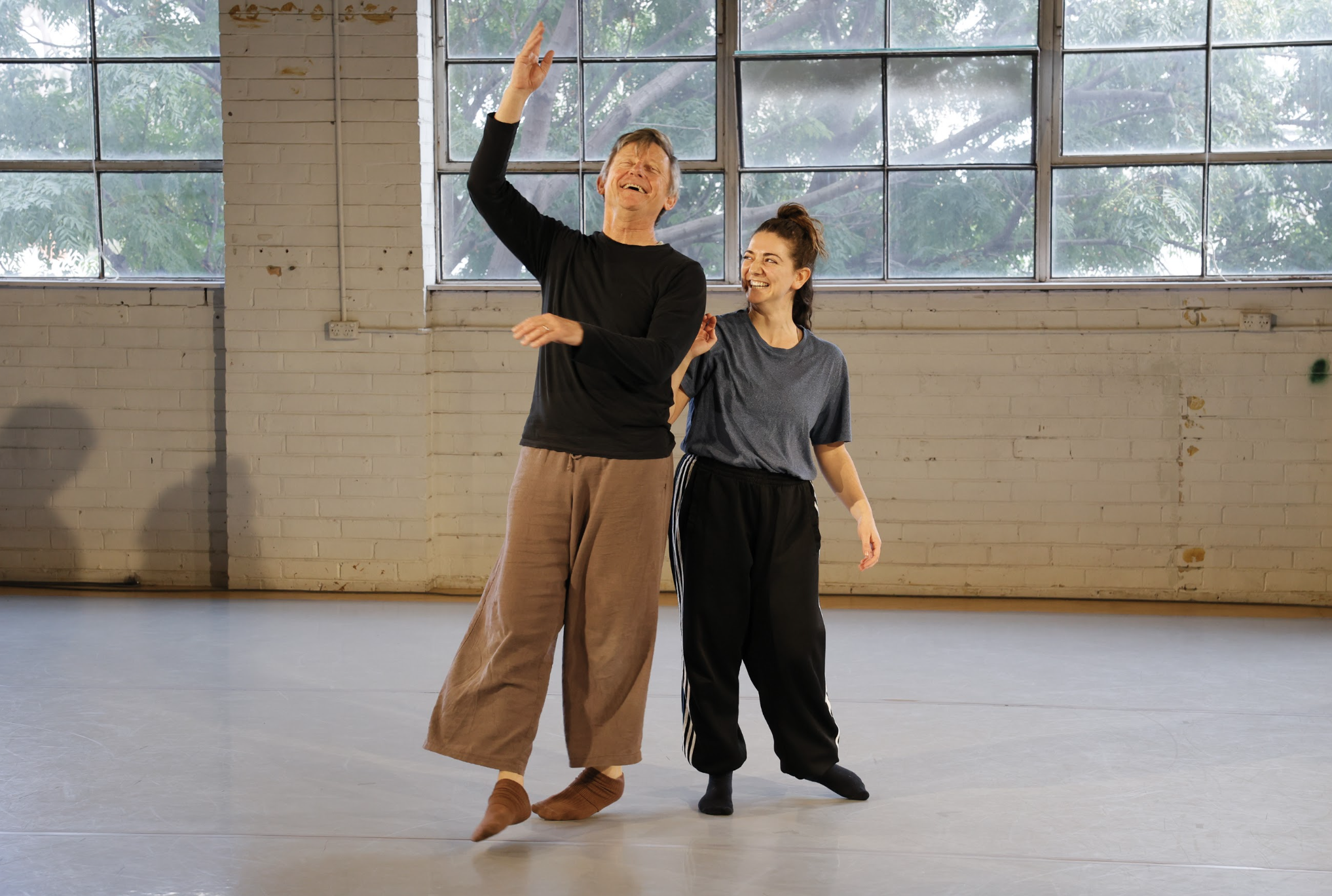
Photos are from Out of Bounds by Aimee Raitman with Martin Hughes. Photographer: Jeff Busby
That amused us, because he has been doing CI for more years than I have been alive, and we attempted to estimate his tally of dance partners, which number in the hundreds.
So, I’ve absorbed all their movements, distilled through his body, and the bodies of others that I have danced with.
Last week, we spoke about getting bored. At that Jam, Martin had decided the antidote in that moment would be to try to ‘dance like Aimee.’ I wonder what that even means when so much of my movement has been collected from dances I’ve had with him, and his has been collected from hundreds of others.
Our bodies like patterns. In many improvisation classes, we are instructed to break our patterns, find ways to move away from habit. Jono Sinatra said to me once on a phone call to find the thing you are interested in it (one a walk, Prahran Square, 2026) and keep being interested in it. I think maybe someone else also said to find the thing you are good at, and be good at it. Oh yes, they quoted Al Wunder (State of Flux, 30 year CI celebration, Dancehouse, 2026).
Why is it then,
that we are always trying to break our patterns in CI?
I think about the way an apple will fall almost the same way from the tree one hundred times. This emboldens me to indulge my habits and patterns in CI. I converse with Steve Paxton. (Fall after Newton, 1987). I also converse with Ashley Macqueen (The Great Northern Hotel,
over a Parma with extra aioli, Monday night jam, 2026). We disagree, with a chuckle.
I remember a long dance we had at a jam some time ago. I wonder how many times we repeated a pattern without realising.
I notice I’ve fallen into spontaneous moments of physical abandon, colliding with bodies in a similar fashion to Magnesium (Paxton, 1972).
Again, it feels like the answer to my question about how to trace my relationship to CI in a choreographic sense, is by tracing constellations over lineages.
The part of the dance where you get lost or stuck.
I read back over my words, and I notice a particular cadence. Cadence is something I’ve been curious about recently. Cadence is intuitive, and something that I don’t think can really be taught. I think cadence is a part of the dance that gets passed on through bodies. Sometimes you get stuck. I find myself encountering all sorts of bodies in the Jam. There are energies that I connect with more, and others less. There is a tension that comes with initiating or declining a dance. I wonder what it would be like to dance with no awareness of the self. A neutral body, with no preconceptions. I think this is why I enjoy going to a new jam so much.
Dancing with people before learning their name. Sometimes dancing with people for days before learning their name. I’ve enjoyed most the dances that don’t involve words. I’m now just spewing out words. I don’t think this has much to do with anything. But I think the rhythm has some kind of correlation. The sentences, the phrases, the ramble. The matter of fact. Feels like the way a dance falls out. Sometimes I wonder whether I am talking about contact, or I’ve forgotten where I am and what really it is we are doing.
The dance lulls.
I like the messiness of the dance. I wonder if everyone considers it this deeply. Would I find my thoughts interesting if I wasn’t writing them? I can only hope this is interesting to someone.
You question whether to stick with the slow dance.
You remember that there is always the small dance.
Often the clunkiest dances feel the most alive in someone else’s body. I notice when I have learnt something new, my dance unravels. Joey Lehrer told me that Alejandro Rolandi said this means there has been a rewiring of pathways (another Monday night jam, Dancehouse, 2026). The experience of this can be infuriatingly frustrating, coming from someone who will sheepishly admit to enjoying the sensation of an effortless flight.
Another dance emerges.