letter: body identity
__________
Volume 3, Edition 1
Author: Jonathan Sinatra
___________
This letter is a collection of loose thoughts in relation to contact improvisation and my perception of body identity, which has been changing through different dance techniques.
“It started with Contact Improvisation, but it turned to dancing into the in between.” What is it? Who is it with?
When people ask me what I do for dance practice I generally reply with a constant statement, “I am not sure, but I am always searching for what it is”. This statement also sums up the paradoxical nature of how I am within contact dance, searching for meeting points and the meeting points of dancing with my contact partner.
During the last five years that I’ve been practicing Contact Improvisation as a dance form, my meeting point, or approach to it has changed. For most of the people I met at dance school, ballet or contemporary techniques were their first or primary forms of dancing. For me it was Contact Improvisation.
So how did I perceive Contact in the beginning?
I saw Contact as a language that was about role-playing of relationships, (this was probably because I’d been studying to become an actor). The role-playing was fleshed out by way of physical touch and interaction in the dance exchange.
My mind summed it up in the functional practice of sticking together with my partner through the rolling point of contact. I worked toward not letting the contact break unless it was in the natural process of the movement.
“A vow of for better or worse. A marriage of two bodies”.
I started contact just after I commenced my first serious relationship. I began to see contact as touch that was loaded with meaning. I would cradle my partner.... Support my partner.... Lean on my partner.... Listen to my partner.... be moved with my partner in conversations.
Of course my partner was doing the same to me. There was juggling of support. The ideal of weight in a give and take relationship.
Those dances seemed to be full of emotions that were physically played out in moments of giving and taking of weight and support. Yet I had no idea how my body was actually moving. Contact was about moments of relationship with my partner.
Then my relationship ended.
I decided to develop my dance beyond emotional contact, which sent me into another area of pursuit. I wanted to have a formal, or more structured dance vocabulary beyond emotional relationships with my dance partner. I can remember thinking what it would be like to have dance conversations with people with form(al) dance vocabularies. “Dancers”. This led to my decision to learn structured dance techniques at an institution. So when dancing with “dancers” I would be speaking and thinking in another language.
In hindsight, starting form(al) technique was a big struggle in the first few years for me. My dance form for a long time seemed to be all over the place. I wasn’t able to manage any structure in relation to space or time.
One interesting realization which has been dispelled in this process of formal dance training, has been the myth that if you have been trained in ballet or contemporary technique, or as Jennifer Newman Preston describes it “hard wiring”, you are quintessentially trained in all dances.
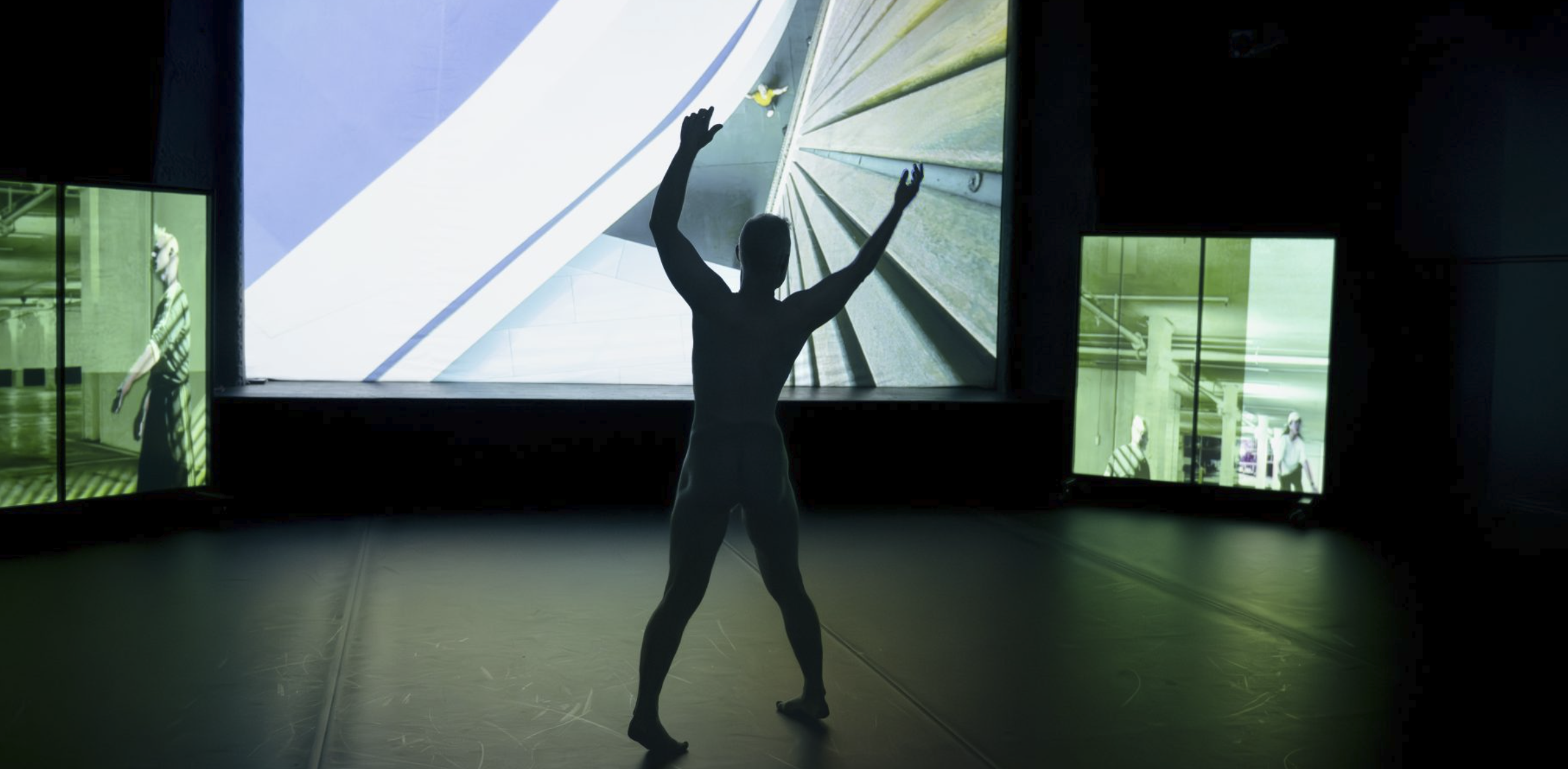
“That day, this body, that time” Solo work by Jonathon at Dancehouse, Melbourne, 2026. Photographer: Gregory Lorenzutti
WRONG!
Later I returned to contact after studying a lot of ‘hard wiring’ as well as solo improvisation dance techniques. This study made my body stronger, more flexible and more articulate. The control these form(al) languages gave me showed up as new problems in my Contact dancing. In the Contact dances my body bumped, smashed, flicked, slid into, over and around my dance partners like a rambling bulldozer. This made the old familiar dance feel very awkward. I realized my Contact dancing body was no longer soft or subtle, nor able to listen for ‘intuneness’ and responsiveness with my contact partner. My body did not meet the contact but continued to push its way through pathways that were programmed into its nervous system for space and time.
The forms of dance training I took at an institution were in the methods of the American postmodern styles. Dancing was empty of emotional meaning or attachment; dancing was embodied in the word I used previously ‘Articulate’, or as Merce Cunningham might say ‘a fact’ of function.
For a while my dancing moved into acrobatics, speed and physical function. The fun was in creating the sense of spectacle (which is not strictly postmodern) for the partner and the mysterious outside viewer. Who was this outside viewer? Most of the time it was my imagination of how the dance looked. My dances for a while became about gross movement in time and space. So I began to wonder what my search into Contact and other forms of dance, had turned up? My dances before ‘hardwiring’ were informal relationship/connection to my Contact partner. At the height of my hard wiring, ways of dancing switched my Contact partner into some sort of routine and apparatus to deal with, sometimes called duo work.
I am now trying to dance with a view of both the subtle and gross soft body. Dancing with form, emotion and intelligence, exploring multi relationships which makes up the dance form of Contact Improvisation.